Making the web faster and more user-friendly
My dream of a container image format: a call to the web community
Andy Bell wrote a great article on the end of responsive images, explaining how the now widely supported sizes="auto" attribute lets browsers figure out the rendered size of lazy-loaded images on their own, removing the need to hand-craft the sizes attribute for most images.
Reading it brought back a dream I've been carrying for years: an image format that would let us write a radically simpler <img> tag — simpler than even sizes="auto" allows. I'll get to it below. But first, a quick recap of Andy's piece for context.
Andy's TL;DR #
For lazy-loaded images (most images on a page), we can drop the hand-crafted sizes and let the browser do the work:
<img
  loading="lazy"
  sizes="auto"
  srcset="
    shirt_300w.jpg   300w,
    shirt_600w.jpg   600w,
    shirt_1200w.jpg 1200w,
    shirt_2400w.jpg 2400w
  "
  alt="A shirt"
/>
For "hero" images — the ones above the fold, candidates to become the page's LCP — we still need to be meticulous with upfront sizing via sizes:
<img
  loading="eager"
  srcset="
    shirt_300w.jpg   300w,
    shirt_600w.jpg   600w,
    shirt_1200w.jpg 1200w,
    shirt_2400w.jpg 2400w
  "
  sizes="(min-width: 1200px) 100vw,
         (min-width: 600px) 600px,
         300px"
  alt="A shirt"
/>
So sizes can mostly go away. But we're still left with that long srcset listing every variant. And that's where my old dream comes back in.
I have a dream #
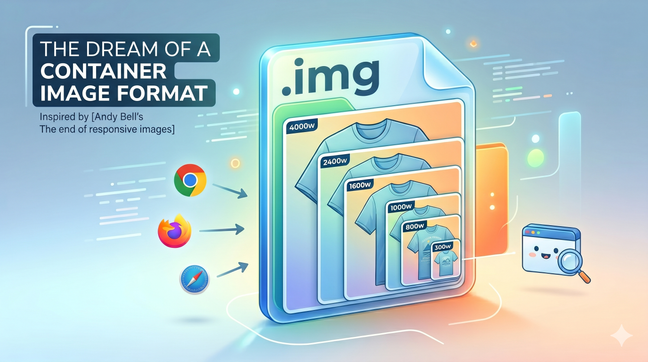
For years I've been dreaming about a container image format — a single file containing every resolution of an image inside it. Think of it as a bundled folder of images, packaged as one.
With a format like that, the <img> tag, at least for lazy images, could be drastically simplified. Something like this:
<img srcset="shirt.imgc *w" sizes="auto" loading="lazy" alt="A shirt" />No srcset. No comma-separated list of widths. The browser would open the file, see which resolutions are inside, and download only the bytes it needs for the size it has to render.
The <img> tag, finally simple again.
A call to the community #
Andy's article shows that the platform can absorb a lot of the complexity we've been carrying around in our markup. I'd love to see us go even further.
To the web standards folks, image format authors, and browser engineers reading this: is a container image format something we could actually build? HTTP range requests already let browsers fetch slices of files. Container formats already exist in other domains. The pieces feel like they're there.
I've been holding this dream for a long time. Could we finally make it real?